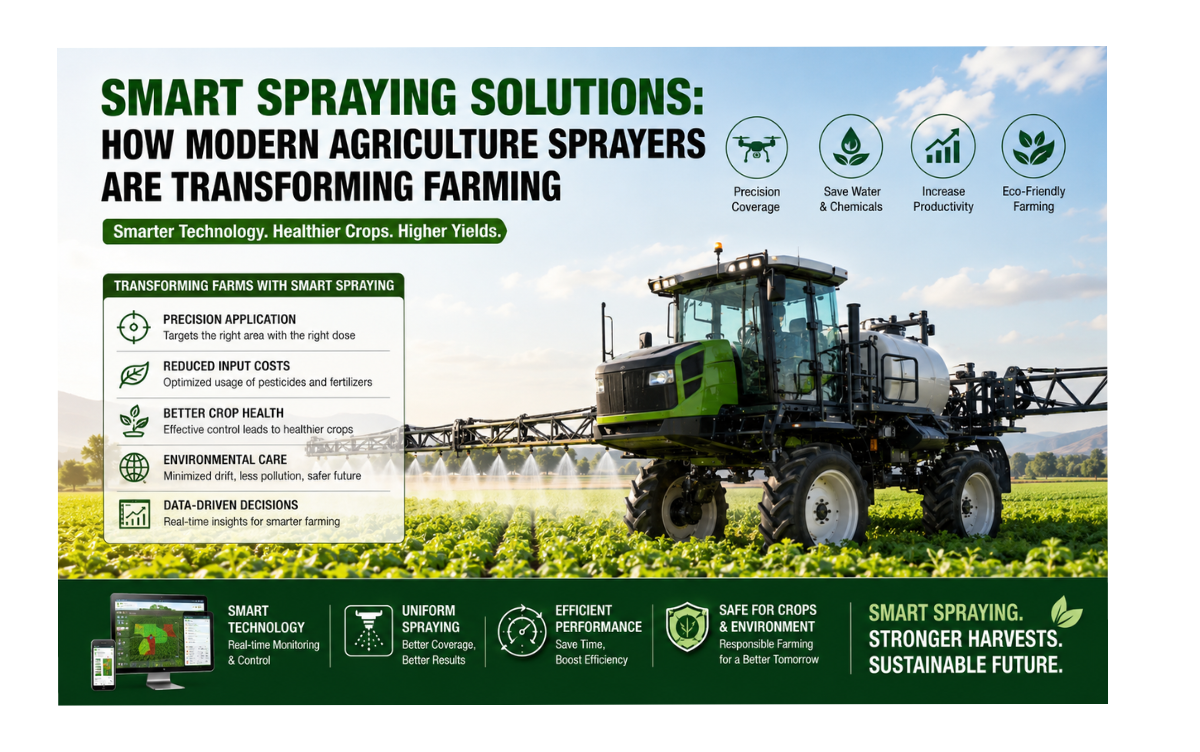
Agriculture has evolved significantly over the past few decades. With increasing pressure to produce higher yields, reduce input costs, and adopt sustainable farming practices, farmers are constantly seeking innovative solutions that improve efficiency and productivity. One of the most important advancements in modern farming is the development of smart spraying solutions.
Agriculture sprayers play a crucial role in crop protection and nutrient management. Whether applying pesticides, herbicides, fungicides, or liquid fertilizers, the effectiveness of these applications directly impacts crop health and farm profitability. Traditional spraying methods often result in uneven coverage, excessive chemical usage, and unnecessary wastage. Smart spraying technology addresses these challenges by providing precision, consistency, and improved resource management.
In this blog, we will explore the importance of smart spraying solutions, the different types of agriculture sprayers, their benefits, and how they are revolutionizing modern farming.
Understanding Smart Spraying in Agriculture
Smart spraying refers to the precise and efficient application of crop protection products and nutrients using advanced spraying equipment. Unlike conventional methods that apply chemicals uniformly across an entire field, smart spraying systems focus on delivering the right amount of product at the right place and at the right time.
The objective is simple: maximize effectiveness while minimizing waste. By ensuring accurate application, farmers can reduce input costs, improve crop performance, and lessen environmental impact.
As agriculture moves toward precision farming, smart spraying has become an essential component of sustainable crop management strategies.
Why Efficient Spraying Matters
Crop protection is one of the most critical aspects of successful farming. Insects, diseases, and weeds can significantly reduce yields if not managed properly. However, over-application of chemicals can lead to increased costs, environmental concerns, and resistance development among pests and weeds.
Efficient spraying helps farmers achieve several important goals:
• Better pest and disease control
• Improved nutrient absorption
• Reduced chemical wastage
• Lower labor requirements
• Increased operational efficiency
• Enhanced crop quality and yield
The quality of spraying equipment directly affects these outcomes. This is why modern farmers are increasingly investing in advanced agriculture sprayers designed for precision and reliability.
Types of Agriculture Sprayers
Different farming operations require different spraying solutions. Understanding the available options helps farmers choose equipment that best suits their crop type, farm size, and operational requirements.
1. Manual Sprayers
Manual sprayers are commonly used on small farms, gardens, and nurseries. These sprayers are cost-effective and easy to operate but may not be suitable for large-scale agricultural operations due to their limited coverage capacity.
2. Knapsack Sprayers
Knapsack sprayers are portable units carried on the operator’s back. They are widely used for spraying pesticides and fertilizers in small to medium-sized fields. These sprayers provide flexibility and are ideal for areas that are difficult to access with larger machinery.
3. Power Sprayers
Power sprayers use motorized pumps to generate pressure and deliver a consistent spray pattern. They are suitable for larger farms and can cover greater areas in less time compared to manual equipment.
4. Tractor-Mounted Sprayers
Tractor-mounted sprayers are designed for commercial farming operations. These sprayers offer high efficiency, larger tank capacities, and wider spray coverage, making them ideal for extensive agricultural fields.
5. Boom Sprayers
Boom sprayers feature multiple nozzles mounted on horizontal booms that ensure uniform distribution of chemicals across large areas. They are commonly used in field crops such as wheat, maize, cotton, and soybean cultivation.
Key Features of Modern Smart Sprayers
Today’s agriculture sprayers are equipped with features that significantly improve performance and spraying accuracy.
Precision Application
Precision is the foundation of smart spraying technology. Advanced sprayers are designed to deliver chemicals accurately to target areas, reducing over-application and ensuring optimal coverage.
This results in:
• Lower chemical consumption
• Better pest management
• Reduced crop damage
• Increased profitability
Uniform Coverage
One of the most common challenges in traditional spraying is uneven application. Some areas receive excessive treatment while others receive insufficient coverage.
Modern sprayers ensure consistent droplet distribution across the crop canopy, leading to improved disease control and healthier plant growth.
Durable Construction
Agricultural equipment operates in demanding environments that involve dust, moisture, rough terrain, and prolonged usage. High-quality sprayers are built using durable materials that can withstand harsh field conditions and provide long-term reliability.
User-Friendly Design
Ease of operation is an important consideration for farmers and farm workers. Modern sprayers feature ergonomic controls, simple maintenance procedures, and efficient operating systems that enhance productivity while reducing operator fatigue.
Low Maintenance Requirements
Equipment downtime can disrupt farming operations during critical crop growth stages. Smart sprayers are designed for reliability and require minimal maintenance, helping farmers save both time and repair costs.
Benefits of Smart Spraying Solutions
The adoption of advanced spraying technology offers several advantages that contribute directly to farm success.
Increased Productivity
Modern sprayers allow farmers to cover larger areas quickly and efficiently. Reduced spraying time means more work can be completed within optimal weather conditions, improving overall farm productivity.
Reduced Input Costs
Chemicals, fertilizers, labor, and fuel represent significant farming expenses. Precision spraying minimizes waste and ensures that every input is utilized effectively, resulting in substantial cost savings over time.
Improved Crop Health
Accurate application ensures crops receive the protection and nutrients they need. Better coverage leads to improved disease prevention, stronger plant development, and healthier yields.
Environmental Sustainability
Sustainable agriculture has become increasingly important worldwide. Smart spraying reduces chemical runoff, groundwater contamination, and unnecessary environmental exposure.
By applying only the required amount of product, farmers can protect natural resources while maintaining productive farming operations.
Better Return on Investment
Although advanced sprayers may require a higher initial investment, the long-term savings achieved through improved efficiency, lower input costs, and higher yields often provide an excellent return on investment.
The Role of Technology in Modern Spraying
Technological innovation continues to reshape agricultural practices. Many advanced sprayers now incorporate precision farming technologies such as:
• GPS-guided spraying systems
• Automated flow control
• Variable-rate application technology
• Sensor-based spraying systems
• Digital monitoring and reporting tools
These technologies enable farmers to make data-driven decisions and optimize resource utilization across their fields.
As precision agriculture continues to expand, smart spraying systems will become even more sophisticated and efficient.
Choosing the Right Agriculture Sprayer
Selecting the appropriate sprayer depends on several factors:
• Farm size
• Crop type
• Terrain conditions
• Chemical application requirements
• Budget considerations
• Maintenance capabilities
Farmers should evaluate both current needs and future expansion plans before investing in spraying equipment. Choosing a high-quality sprayer from a trusted manufacturer ensures consistent performance, durability, and long-term value.
The Future of Smart Spraying
The future of agriculture lies in precision, automation, and sustainability. Smart spraying technology is expected to play an increasingly important role in helping farmers meet growing food demands while minimizing environmental impact.
Emerging innovations such as artificial intelligence, drone-based spraying, machine vision systems, and autonomous agricultural equipment are likely to further enhance spraying accuracy and operational efficiency.
Farmers who embrace these advancements will be better positioned to improve productivity, reduce costs, and achieve sustainable growth in an increasingly competitive agricultural landscape.
Conclusion
Smart spraying solutions are transforming modern agriculture by making crop protection and nutrient application more precise, efficient, and sustainable. From reducing chemical waste to improving crop health and increasing profitability, advanced agriculture sprayers provide numerous benefits for farmers of all sizes.
As farming continues to evolve, investing in reliable and innovative spraying equipment is no longer just an option it is a strategic decision that can significantly influence productivity and long-term success. By adopting smart spraying technologies, farmers can improve operational efficiency, protect the environment, and build a more sustainable future for agriculture.
Agriculture & Food Processing Machinery Manufacturer ★ AaryaTech By Ashirwad Agro Food Technology Pvt. Ltd. ★ Agriculture & Food Processing Machinery Manufacturer ★ AaryaTech By Ashirwad Agro Food Technology Pvt. Ltd. ★ Agriculture & Food Processing Machinery Manufacturer ★ AaryaTech By Ashirwad Agro Food Technology Pvt. Ltd. ★Agriculture & Food Processing Machinery Manufacturer ★ AaryaTech By Ashirwad Agro Food Technology Pvt. Ltd. ★ Agriculture & Food Processing Machinery Manufacturer ★ AaryaTech By Ashirwad Agro Food Technology Pvt. Ltd. ★ Agriculture & Food Processing Machinery Manufacturer ★ AaryaTech By Ashirwad Agro Food Technology Pvt. Ltd. ★
Order by phone
6359132255

AaryaTech, operating under Ashirwad Agro Food Technology Pvt. Ltd., is a prominent manufacturer and supplier of industrial food processing, packaging, and powder mixing machinery. They specialize in building equipment for the agricultural, food, and pharmaceutical sectors.
shop
about
© Copyright 2026 AaryaTech By Ashirwad Agro Food Technology Pvt. Ltd. | All Rights Reserved | Design by 247 Digital Marketing

Affordable, reliable and customized machinery for farmers, food processors, entrepreneurs, and small businesses.